

Execution support for healthcare data, reporting, and platform teams.
Scalar helps healthcare technology and analytics leaders stabilize reporting dependencies, support cloud data platform modernization, and add senior engineering capacity where internal teams are carrying delivery pressure.
Common signals we see
Fragile reporting logic
Critical reports depend on brittle upstream data flows.Modernization drag
Legacy platforms slow cloud and analytics progress.Execution gaps
Open senior roles delay hands-on delivery work.
Modernization & Analytics Execution
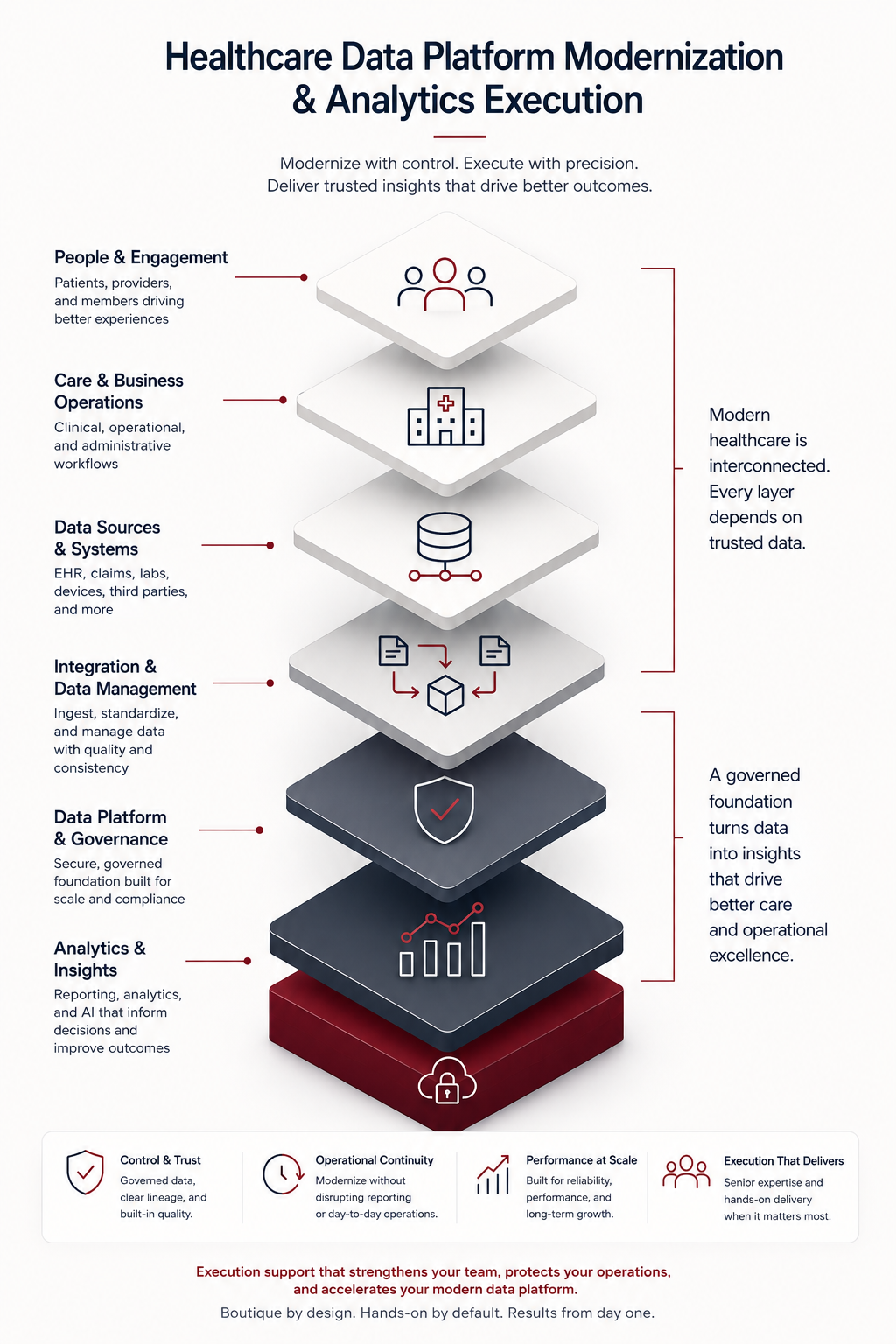
Healthcare data initiatives lose momentum when reporting, analytics, and platform dependencies are not supported at the execution layer.
Healthcare Data Platform Modernization & Analytics Execution
Healthcare data environments have become deeply interconnected. Clinical and EHR data, claims and payer information, provider networks, finance, operations, quality measures, and patient engagement increasingly depend on a shared data foundation. When these domains rely on different systems, definitions, refresh cycles, and legacy processing logic, even a well-designed modernization program can become difficult to execute without disrupting reporting or day-to-day operations.
Scalar Solutions works with healthcare CTOs, data leaders, and engineering teams to modernize the healthcare data platform behind these dependencies. Our work spans data engineering and integration, cloud and lakehouse modernization, reporting and analytics, data quality, reconciliation, governance, and the transition of legacy workloads to modern platforms such as Azure and Databricks.
The objective is not simply to move data to a new technology stack. Critical healthcare reporting must remain dependable throughout the transition. Clinical, operational, financial, quality, and provider-facing outputs still need consistent definitions, traceability, and trusted data pipelines while new platforms are introduced.
Modernization Without Losing Operational Continuity
Successful healthcare data platform modernization requires control across the full lifecycle—from source-system integration and governed storage through transformation, semantic modeling, reporting, and analytics. Data quality and lineage must remain visible, legacy and modern environments may need to coexist, and results must reconcile before critical workloads can safely transition.
Scalar supports this execution layer with senior, hands-on healthcare data engineering and analytics expertise. We help internal teams stabilize critical pipelines, modernize warehouses and reporting environments, improve Power BI and analytics delivery, resolve data dependencies, and move priority initiatives forward when existing teams are constrained by production support or limited senior capacity.
The result is a more reliable, governed, and scalable healthcare data environment—built to support trusted reporting today while creating the foundation for broader analytics, automation, and AI initiatives tomorrow.
Execution areas
Where healthcare teams typically need stronger execution. These are the practical data, reporting, analytics, and platform workloads where Scalar can support internal teams or delivery partners.
Reporting and analytics stabilization
Support production reporting, BI model cleanup, metric logic, dashboard dependencies, and data quality issues that slow operational decision-making
Environment and architecture read
Help assess where reporting, warehouse logic, platform ownership, and modernization backlog are creating delivery risk.
Cloud data platform modernization
Add experienced execution capacity around Azure-aligned data platforms, warehouse modernization, migration support, and analytics engineering workloads.
Healthcare analytics delivery support
Assist internal teams supporting claims, member, operational, quality, finance, or provider-facing analytics environments.
Engagement model
A practical model for healthcare technology leaders.
Scalar can align to the need behind the role: permanent senior talent, interim execution support, or a technical read on the current environment.
01 Senior full-time talent
For teams hiring experienced data platform, analytics, BI, or cloud data engineers and needing stronger technical qualification before candidates reach leadership.
02 Interim capacity while roles are open
Provide senior hands-on support while your team hires for VP-directed platform, BI, data engineering, or analytics delivery roles.
03 Qualified engineering talent
Provide vetted senior data engineers, BI engineers, analytics engineers, and platform specialists who can work inside existing delivery processes.
04 Environment evaluation
For leaders who need an operator-level read on what sits behind the role, the reporting dependency map, or the modernization pressure inside the environment.
05 Execution coverage
For active modernization, reporting cleanup, migration, analytics backlog, or platform stabilization work where waiting for a full-time hire creates delivery drag.
06 Integrator support
For systems integrators and delivery partners that need qualified W-2 engineering capacity without lowering technical quality or compliance discipline.
Insights

Unifying Claims and EMR Data for Value-Based Care Using Azure Data Lake
As the healthcare industry pivots toward value-based care (VBC), the ability to integrate structured claims data with semi-structured EMR data has become essential for delivering actionable insights, improving outcomes, and aligning incentives across stakeholders.

Automating Clinical Trial Data Pipelines with Azure Data Factory and Databricks
In the pharmaceutical and life sciences industries, clinical trial success depends not only on scientific innovation but also on how well organizations manage their data. From patient recruitment to final analysis, each phase generates complex,

Using Azure Databricks for Real-Time Clinical Decision Support
Healthcare systems worldwide are under increasing pressure to deliver more accurate, timely, and personalized care. The traditional model of reactive medicine, waiting for symptoms to appear before treating them, is giving way to proactive,