

Modernize Retail Data Without Slowing the Business.
Retail technology teams are expected to modernize platforms while sales, inventory, merchandising, finance, and customer reporting continue to run every day. Scalar adds senior, hands-on execution where that work is getting constrained.
Retail Data Platform Execution
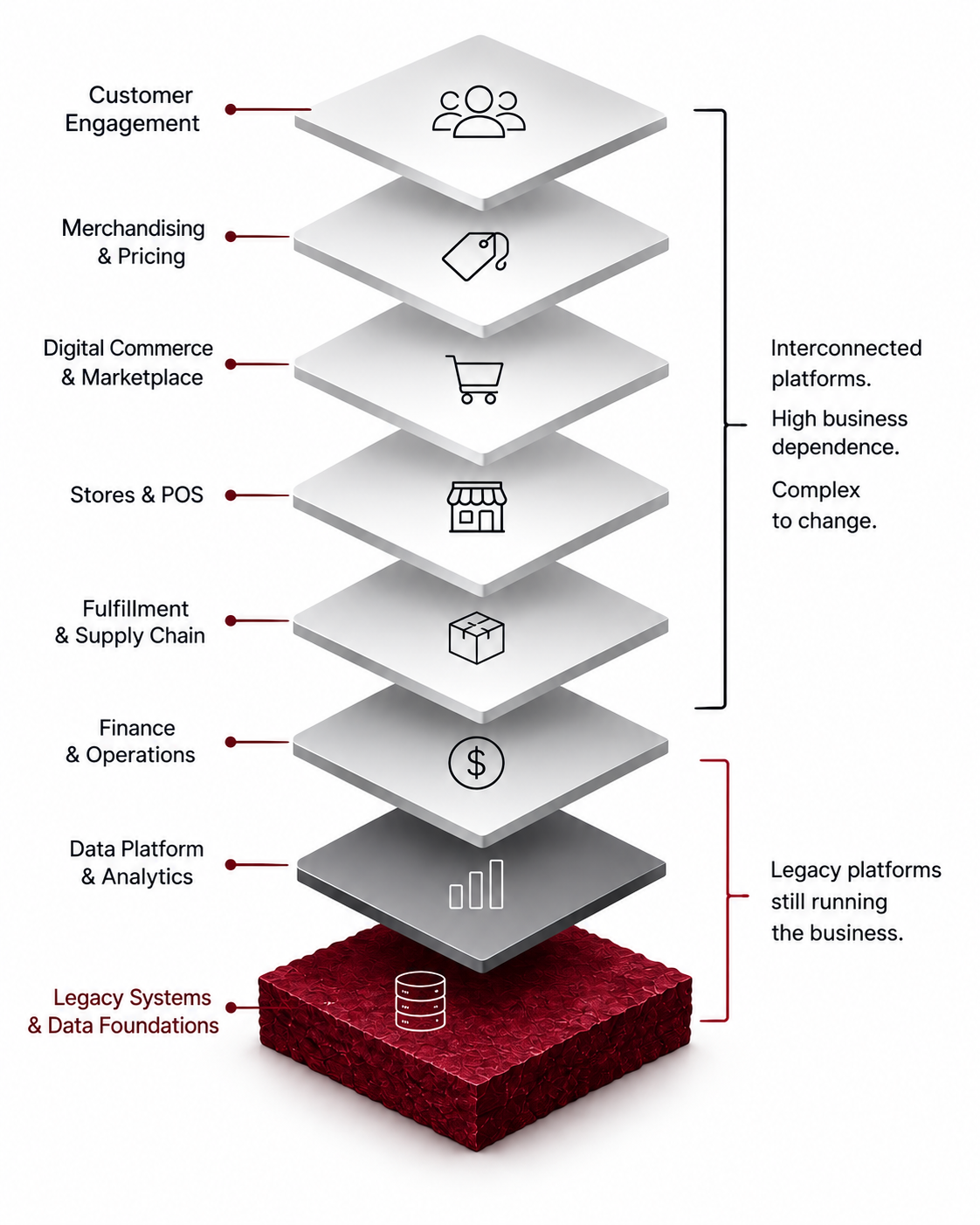
Retail and e-commerce data environments have become far more complex than traditional sales and inventory reporting. CTOs and data leaders are now supporting interconnected platforms across POS, digital commerce, merchandising, fulfillment, loyalty, finance, and customer analytics—often while modernizing legacy warehouses, pipelines, and BI environments that still support daily operations.
Scalar works with retail technology teams at this execution layer. We help stabilize critical data flows, modernize legacy platforms, improve reporting and analytics, and address delivery gaps that can slow larger transformation efforts. When the constraint is senior capacity, we can also provide experienced data engineers, BI specialists, and platform resources who are technically evaluated against the actual environment and work to be delivered.
The focus is practical: keep the business running, reduce platform risk, and move priority data initiatives forward without adding unnecessary consulting overhead.
When an Open Role Is the Signal
An open position often points to a broader delivery constraint.
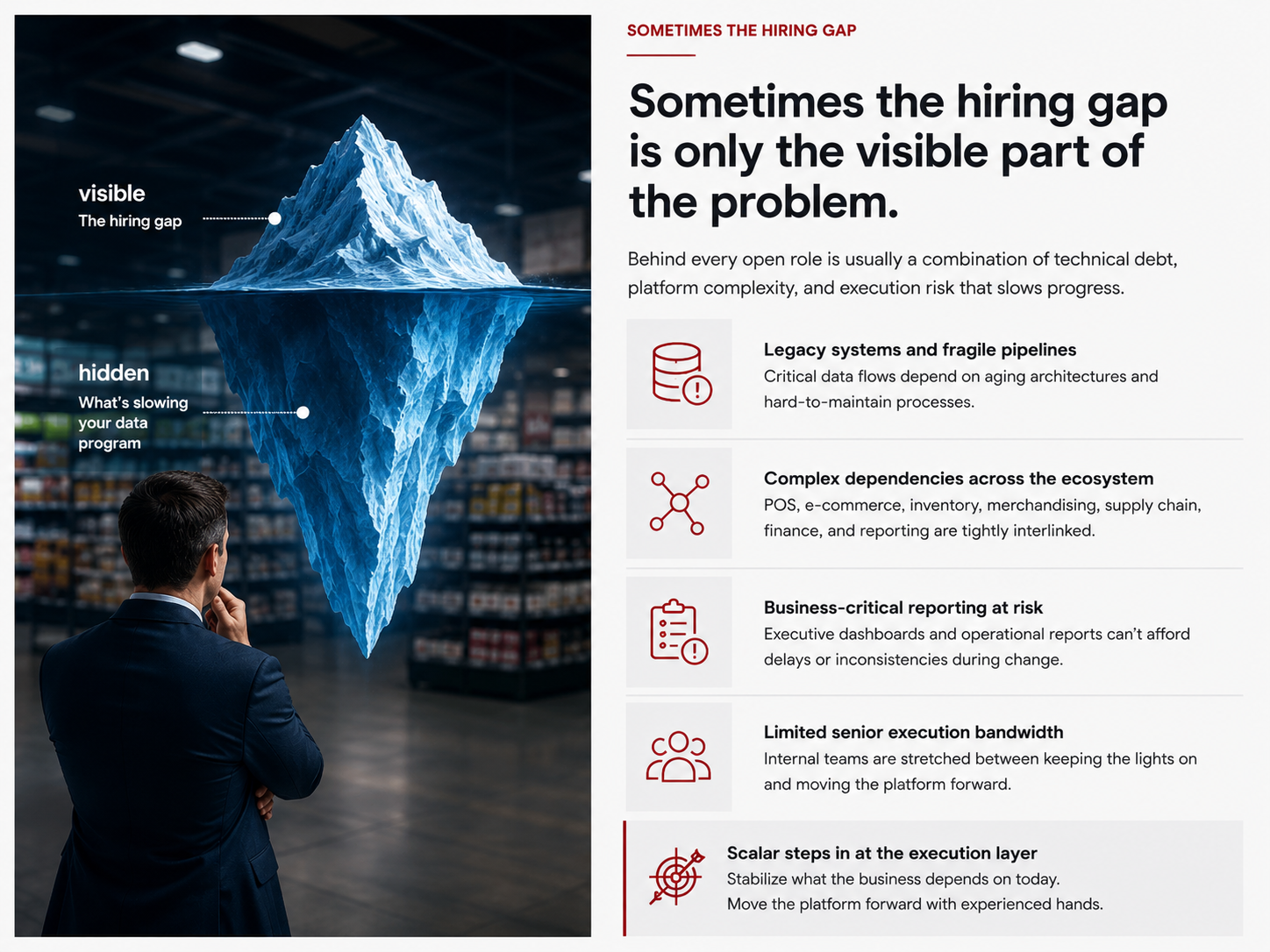
For a retail CTO or VP of Data Engineering, the immediate issue may look like a hiring gap. But the real constraint is often deeper: legacy platform dependencies, production reporting risk, modernization backlog, or a lack of senior bandwidth to move the work without disrupting day-to-day operations.
That is why Scalar starts with the work behind the role—not the résumé. We look at what is blocked, what the existing team is carrying, and where experienced execution capacity can create the most leverage.
The response should match the actual constraint.
If the problem is an execution backlog, Scalar can add senior hands-on capacity. If the role is open, we can provide interim coverage while the permanent search continues. And when the need is structural, we can support contract-to-hire or permanent talent that is technically evaluated against the real environment and ownership expectations.
SCALAR'S ROLE
Stabilize what the business depends on today.
Move priority modernization work forward.
Add experienced engineering capacity where the current team is constrained.
Retail technology leaders are expected to modernize data platforms while keeping critical reporting, integrations, and production workloads running without interruption. Scalar works alongside internal teams to stabilize existing environments, modernize legacy data platforms, and move priority engineering work forward when internal capacity is constrained.
We bring senior, hands-on experience across data engineering, analytics, cloud platforms, and BI—focused on execution rather than adding another layer of consulting overhead..
Where Scalar Supports Retail Data Teams
Data Platform Modernization
Modernize legacy warehouses, ETL processes, and reporting environments onto Azure and Databricks without disrupting production operations.
Redesign data models and platform components to improve scalability, maintainability, and performance.
Support phased migrations with reconciliation, parallel runs, and controlled cutover of critical retail workloads.
Data Engineering & Integration
Build and modernize data pipelines across POS, e-commerce, inventory, order management, merchandising, loyalty, supply chain, and finance.
Develop scalable ingestion and transformation pipelines using Azure Data Factory, Databricks, Spark, and Delta Lake.
Improve data quality, lineage, and consistency across operational and analytical systems
Retail Data Execution
Integrate store, digital, inventory, fulfillment, customer, and financial data into consistent analytical flows.
Address delivery backlogs around migrations, pipeline redevelopment, reporting transitions, and production stabilization.
Add senior engineering capacity when internal teams are constrained by production support, modernization work, or open technical roles.
Reporting & Analytics Modernization
Modernize Power BI, semantic models, and enterprise reporting environments that depend on legacy warehouse logic.
Improve refresh reliability, query performance, metric consistency, and source-to-report traceability.
Support migration of critical reporting workloads while maintaining continuity for business users.
Where Modernization Gets Hard
The target architecture is rarely the biggest challenge.
The difficulty is moving toward the target architecture while existing platforms continue supporting daily sales, inventory, fulfillment, merchandising, finance, and executive reporting. Retail technology teams rarely have the option to pause production while warehouses, pipelines, semantic models, or BI platforms are rebuilt. Legacy business rules must be understood, critical reports must continue to reconcile, and source-system changes still need to be absorbed throughout the transition. At the same time, engineering teams are expected to deliver new cloud and Databricks capabilities, improve data quality, and support growing analytics demand. Modernization therefore becomes an execution problem—balancing platform change with operational continuity, technical risk, and limited senior engineering capacity.
01 / LEGACY LOGIC
Critical business rules still live in the old environment.
Stored procedures, ETL jobs, warehouse tables, semantic models, and reports often contain years of accumulated business logic. Modernization requires understanding those dependencies before they can be safely replaced or moved.
02 / COMPETING PRIORITIES
Production and transformation compete for the same team.
The engineers expected to build the new platform are often the same people supporting failed pipelines, reporting issues, source-system changes, and daily operational requests. Modernization slows because production cannot.
03 / RECONCILIATION
Moving the workload is not enough—the data still has to reconcile.
Sales, inventory, customer, order, and financial data must continue to tie back to the systems and reports the business already trusts. Migration success depends on controlled validation, reconciliation, and cutover.
04 / SENIOR CAPACITY
The skills gap often appears in the middle of the program.
Architecture, Databricks, cloud data engineering, BI, or migration expertise may become constrained after the program is already underway. Hiring can take months while delivery commitments remain unchanged.
Common Signals We See
01 / REPORTING DEPENDENCIES
Critical reporting is tied to fragile upstream logic.
Sales, inventory, merchandising, margin, and executive reporting may depend on transformations that are difficult to change without introducing operational risk.
02 / MODERNIZATION PRESSURE
New platforms are being built while legacy environments still run.
Cloud migrations, Databricks adoption and BI modernization often happen alongside SQL warehouses, legacy ETL and production reports that still require daily support.
03 / SENIOR EXECUTION GAP
The roadmap is clear. Experienced hands are the constraint.
Open senior data, BI or platform roles can slow migrations and backlog delivery when the work requires engineers who can own production issues as well as modernization.
Discuss the work that is not moving fast enough.
Whether the immediate signal is a reporting dependency, a delayed modernization initiative, or an open senior role, start with a technically led discussion of the environment and the work behind it.
Technical perspectives for retail data leaders.

A Deep Dive into Azure Synapse and Databricks Integration
Retailers today stand at the crossroads of digital transformation and consumer expectations. Gone are the days when siloed databases or on-premises servers could power business decisions. With customers shopping across channels, interacting with brands in real time, and expecting personalized experiences, data must be fast, unified, and intelligent.

Azure Data Lake and Databricks for Unified Retail Intelligence
In the modern retail landscape, data is a powerful competitive differentiator, but only when it’s unified, accessible, and actionable. Retailers now collect information from a variety of sources: point-of-sale (POS) systems, mobile apps, e-commerce platforms, customer loyalty programs, and supply chain systems.

Deploying Azure Migrate and Databricks at Scale
For retail enterprises, the cloud is no longer a future consideration—it is a current necessity. As digital shopping trends evolve, and as customers interact across in-store, mobile, and online touchpoints, the volume and complexity of retail data have grown dramatically.

Using Azure Databricks for Real-Time Recommendation Engines
Today’s retail customers expect more than just seamless shopping—they expect experiences tailored uniquely to their preferences, behaviors, and moments. The bar for personalization has risen dramatically, and retailers who fail to deliver face a decreasing engagement and lost loyalty.