
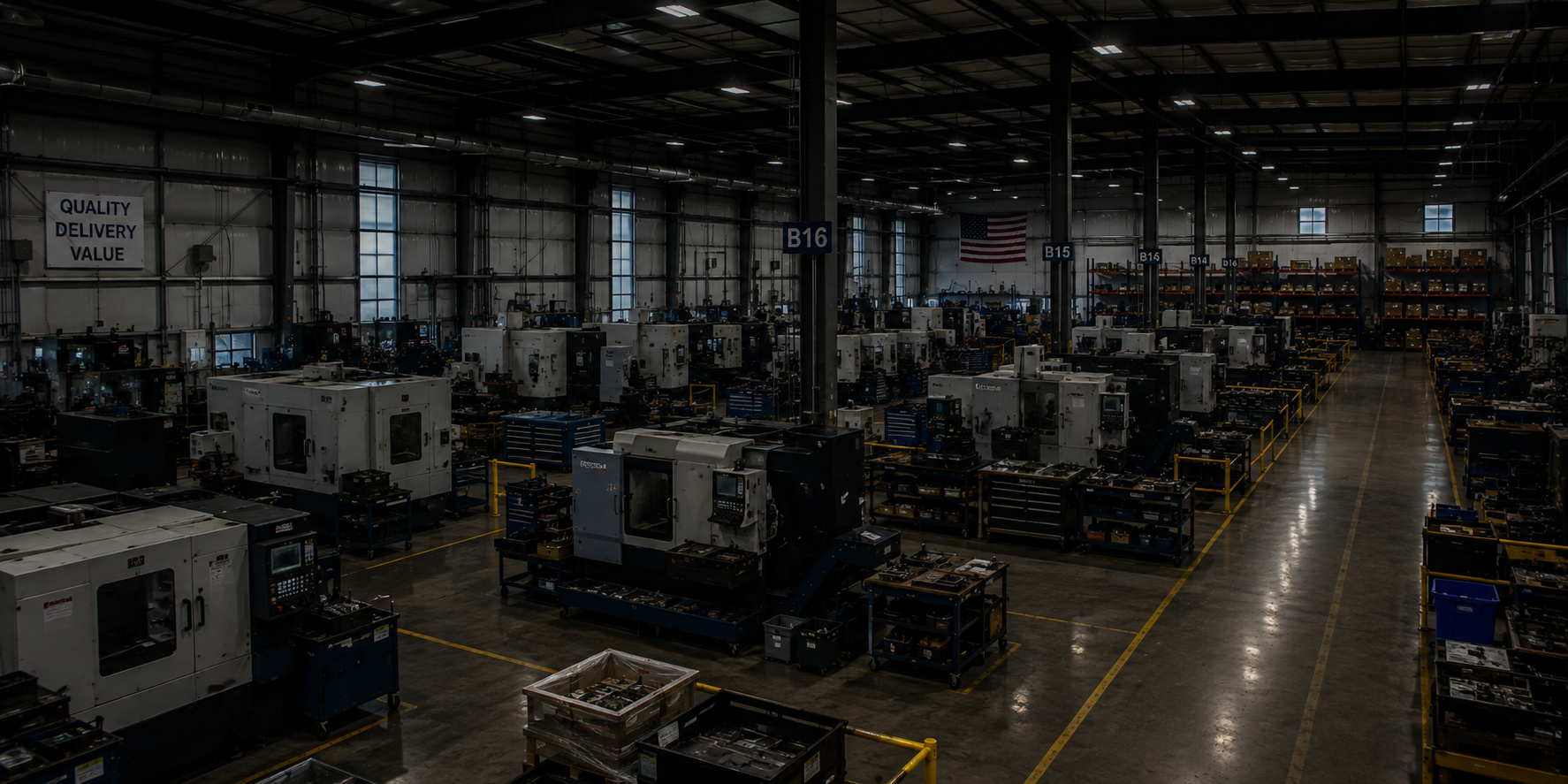
Modernize Manufacturing Data Without Disrupting Production.
Manufacturing technology teams are expected to modernize data platforms while plants, ERP processes, quality reporting, supply-chain operations, and executive visibility continue without interruption. Scalar adds senior, hands-on execution where that work is getting constrained.
Manufacturing data has to connect the plant floor to the enterprise.
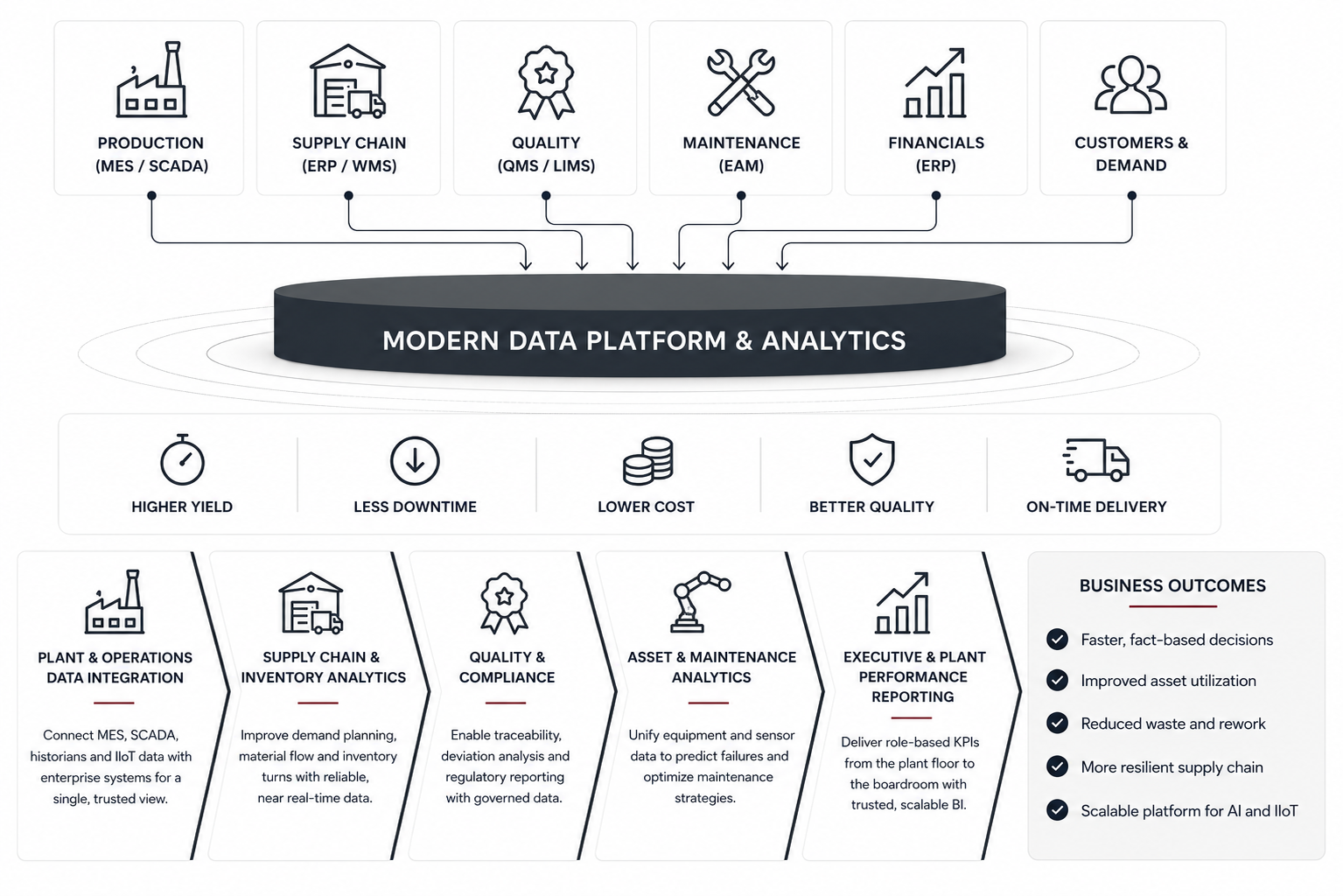
Manufacturing data rarely lives in one environment. Production, quality, maintenance, inventory, planning, procurement, supply chain, and finance often depend on different systems, processing cycles, and ownership models. ERP, MES, SCADA, historians, WMS, QMS, PLM, and enterprise data platforms may all contribute to the same operational or executive decision.
Modernization becomes difficult when years of plant and business logic are embedded across integrations, warehouse tables, ETL processes, reports, and local workarounds that cannot simply be retired. Scalar works with CIOs, VPs of Data Engineering, and technology leaders at this execution layer—stabilizing the operations that depend on it today while helping internal teams advance the underlying data platform.
The objective is practical: improve visibility, reduce platform risk, and modernize without creating another transformation layer between technology teams and the manufacturing operation.
An open engineering role often points to a broader manufacturing delivery constraint.
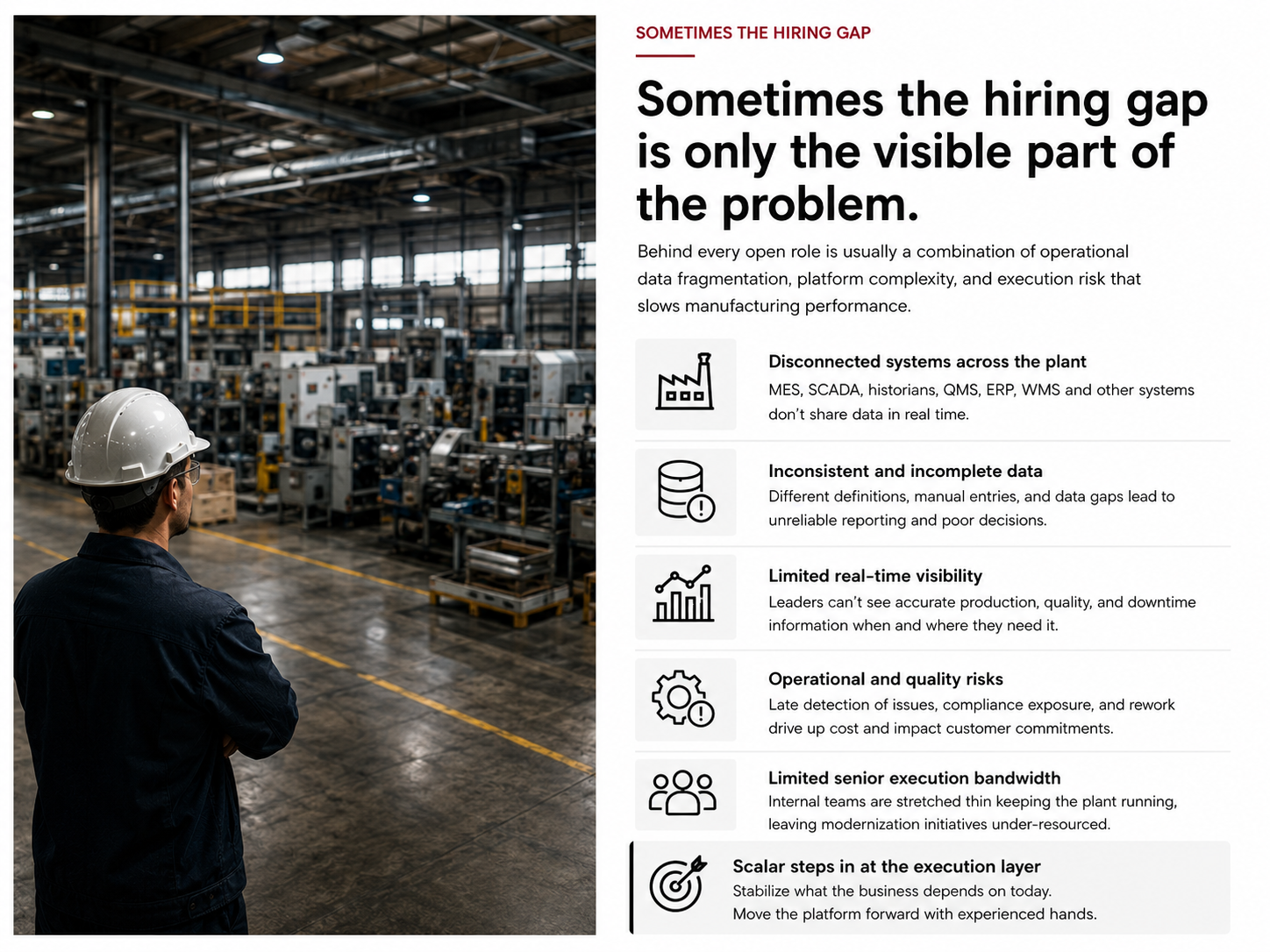
For a manufacturing CIO or VP of Data Engineering, the immediate issue may look like a hiring gap. The underlying constraint is often larger: an ERP or MES integration backlog, unreliable plant reporting, cloud migration work, accumulated technical debt, or insufficient senior bandwidth to support both production and modernization.
Scalar starts with the work behind the role—not the résumé. We look at what is blocked, what production dependencies must be protected, and whether the right response is targeted execution support, interim capacity, or longer-term technical talent.
The response should match the actual constraint.
If a migration or reporting backlog is the problem, Scalar can add senior hands-on execution. If a key role is open, we can provide interim coverage while permanent hiring continues. When the need is structural, we can support contract-to-hire or permanent talent technically evaluated against the real manufacturing environment.
Senior execution across the data work connecting operations and the enterprise.
Scalar focuses on the engineering work between architecture decisions and dependable production—where manufacturing data has to be integrated, reconciled, modernized, and made reliable for operational and enterprise use.
Data Platform Modernization
Modernize legacy SQL warehouses, ETL processes, and reporting environments onto Azure and Databricks/Snowflake.
Support phased migration while plant and enterprise reporting continue to operate.
Redesign platform components for performance, maintainability, governance, and scale.
Data Engineering & Integration
Build and modernize pipelines across ERP, MES, SCADA/historian, WMS, QMS, PLM, maintenance, and finance.
Standardize ingestion and transformation across plant, enterprise, partner, and cloud sources.
Improve data quality, lineage, exception visibility, and cross-system consistency.
Manufacturing Data Execution
Support production, quality, yield, downtime, maintenance, inventory, and supply-chain data workloads.
Address delivery backlogs around migrations, pipeline redevelopment, historical conversion, and stabilization.
Add senior engineering capacity when internal teams are constrained by production support or active transformation work.
Reporting & Analytics Modernization
Modernize Power BI, semantic models, KPI logic, and operational reporting tied to legacy warehouse processes.
Improve refresh reliability, performance, metric consistency, and source-to-report traceability.
Transition plant and executive reporting without losing confidence in the numbers used to run the business.
The target architecture is rarely the biggest manufacturing challenge.
The difficulty is changing the data environment while production, planning, quality, maintenance, inventory, and financial processes continue to depend on it. A technically sound cloud architecture can still fail operationally if business rules are lost, plant data no longer reconciles, or reporting teams cannot trust the new outputs.
Manufacturing modernization therefore becomes an execution problem:
What that execution typically requires:
Map operational dependencies first — understand how MES, SCADA, ERP, WMS, QMS, historians, reporting, and downstream processes are connected before changing the platform.
Preserve embedded business logic — many critical rules live inside legacy ETL jobs, stored procedures, reports, interfaces, and plant-specific workflows.
Protect production continuity — modernization cannot interrupt manufacturing operations, order flow, quality processes, maintenance activity, or inventory movement.
Reconcile legacy and modern environments — run old and new pipelines in parallel where necessary and validate that outputs remain consistent.
Maintain data trust — operational, financial, and reporting teams need confidence that the new platform produces the same or better business results.
Handle plant-level variation — different facilities often use different equipment, naming standards, source systems, and operating processes.
Manage cross-system dependencies — changes in one area can affect planning, procurement, quality, maintenance, logistics, or finance downstream.
Validate at the business level, not just technically — successful migration means production totals, inventory balances, quality metrics, and financial reporting still reconcile.
Create enough senior engineering bandwidth — experienced engineers are often required to resolve edge cases, undocumented logic, integration failures, and performance issues.
Modernize incrementally — moving capabilities in controlled stages reduces operational risk and allows issues to be identified before they affect production.
01 /EMBEDDED LOGIC
Critical manufacturing rules still live in legacy processes.
Production mappings, cost logic, quality rules, transformations, and KPI calculations may be distributed across ERP extracts, stored procedures, ETL jobs, warehouse tables, spreadsheets, and BI models.
02 / OT + IT DEPENDENCIES
Plant and enterprise systems do not change on the same timetable.
MES, historians, equipment data, ERP, WMS, and enterprise analytics often have different owners, release cycles, reliability expectations, and integration patterns.
03 /RECONCILIATION
Moving the pipeline is not enough—the operational numbers must still tie.
Production counts, scrap, yield, inventory, work orders, shipments, and financial outputs must continue to reconcile with the systems and reports operations already trusts.
04 /SENIOR CAPACITY
The skills gap often appears after the program is already underway.
Architecture, Databricks, data engineering, BI, migration, and integration expertise may become constrained while internal teams remain responsible for production support.
Common Signals We See
01 / Operational reporting depends on fragile upstream logic.
Production, quality, inventory, cost, maintenance, and executive reporting may depend on transformations that are difficult to change without introducing operational risk.
02 / MODERNIZATION PRESSURE
New platforms are being built while legacy environments still run.
Cloud migrations, Databricks adoption, BI modernization, and ERP programs often proceed while existing warehouses, interfaces, and plant reporting still require daily support.
03 / SENIOR EXECUTION GAP
The roadmap is clear. Experienced hands are the constraint.
Open senior data, BI or platform roles can slow migrations and backlog delivery when the work requires engineers who can own production issues as well as modernization.