
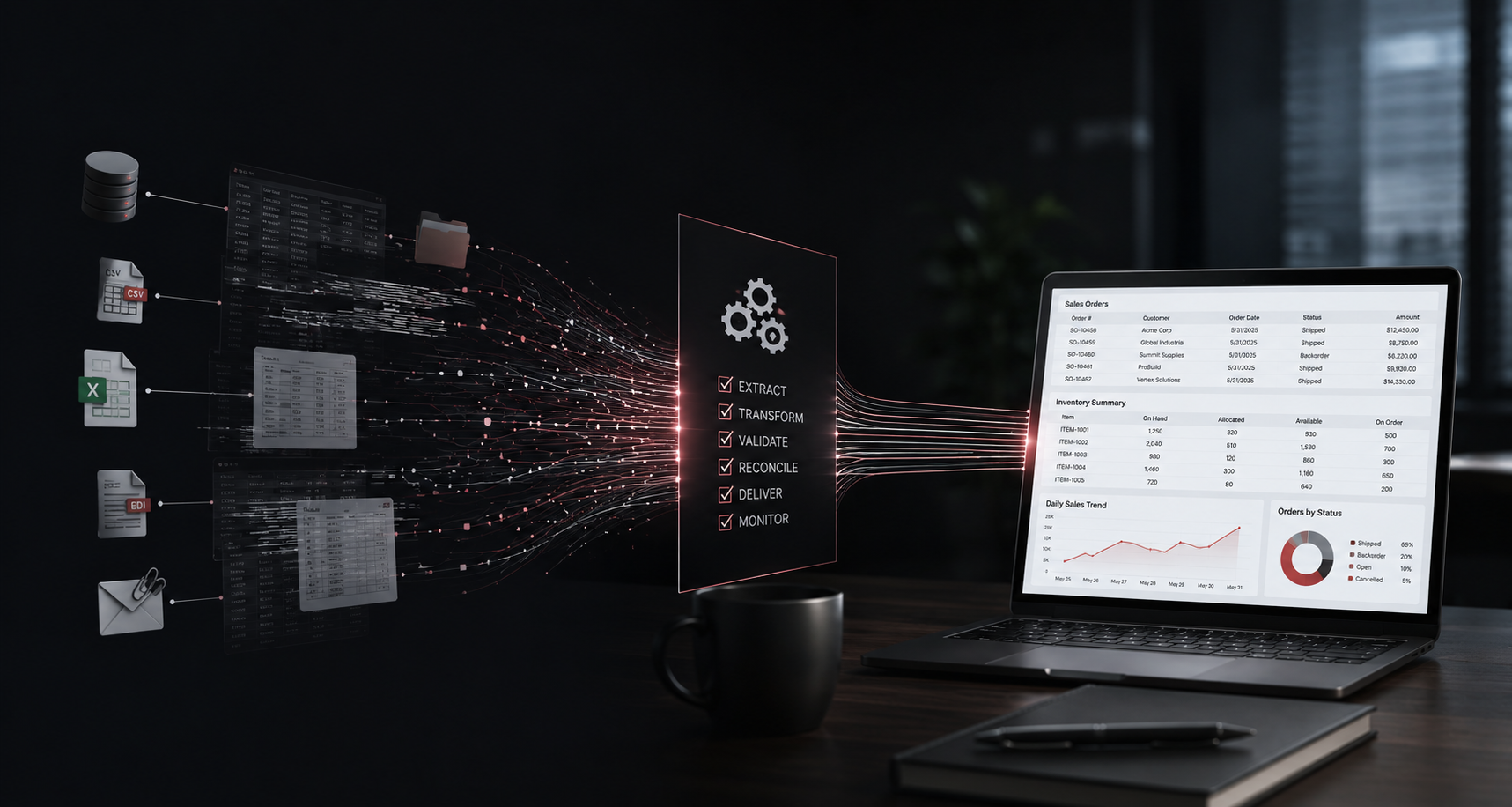
Reliable Data. Ready for Reporting.
We take the recurring data work behind your reports—extracting, cleaning, reconciling, and maintaining data from your ERP and operational systems—so your team gets trusted, reporting-ready information without building an internal data engineering team.
Flat-rate managed service
No hourly consulting meter
No large platform transformation required
Start with the data that matters most
Managed Data Services
Your systems already have the data. Getting it ready is the hard part.
Many organizations have invested in ERP and operational systems, yet management reporting still depends on exports, spreadsheets, manual cleanup and one person who knows how the numbers fit together.
Fragile reporting
Small source changes create late dashboards, mismatched totals, and avoidable rework.
Your teams should use data—not continually repair it.
THE OPERATIONAL GAP
Recurring cleanup
Manual fixes return every reporting cycle because no one owns the underlying process.
Unclear ownership
Business and IT teams each carry part of the burden, but the full workflow remains unmanaged.
02 PREPARE
Clean
Standardize formats, normalize values, remove duplicate conditions and apply agreed business rules.
01 CONNECT
Extract
Connect securely to ERP, databases, APIs, operational applications or scheduled files.
HOW SERVICE RUNS
03 VERIFY
Validate
Check completeness, reconcile key measures and identify unexpected data conditions.
04 OPERATE
Monitor
Run and monitor scheduled processing so the data remains usable as source systems change.
One accountable flow from source to business output
05 CONSUME
Deliver
Provide reporting-ready data for Excel, Power BI, dashboards, automation or other downstream uses.
EXPERIENCE
Managed service economics. Enterprise-grade ETL thinking.
Scalar Solutions' managed data service is built on long-standing experience designing and operating ETL, data integration, reporting and modern data-platform solutions.
Our background spans traditional database and ETL environments through cloud-based data engineering and analytics platforms. That experience matters because reliable managed data is not simply about moving records from one system to another — it requires understanding source behavior, transformations, reconciliation, failure handling and downstream reporting dependencies.
20+ years of data movement and integration
Experience across SQL-based integration, ETL/ELT, enterprise reporting, data warehousing, cloud data engineering and modern analytics architectures.
Operational reliability over tool complexity
We use the architecture appropriate for the client. The goal is not to sell a large platform; it is to produce dependable data that the business can actually use.
Senior technical oversight
Managed services are grounded in hands-on data engineering and platform experience rather than generic outsourced support.
Different systems. Familiar data problems.
We focus on operational environments where valuable business data exists, but obtaining a consistent reporting view still requires too much manual work.
Manufacturing
Production & inventory confidence
Align item, plant, supplier, work-order, and inventory data across operational systems.
Managed outcome: fewer reconciliation cycles and more dependable operational reporting.
INDUSTRY SCORECARDS
Wholesale & distribution
Order-to-margin visibility
Bring customer, product, order, shipment, and pricing data into one governed flow.
Managed outcome: cleaner fulfillment, sales, and margin analysis
Healthcare services
Operational reporting integrity
Standardize encounter, location, provider, scheduling, and service-line information.
Managed outcome: consistent management reporting with traceable exceptions.
Construction & specialty contractors
Project controls that reconcile
Connect project, labor, cost-code, commitment, and billing data across teams.
Managed outcome: clearer work-in-progress, cost, and project performance reporting.
Predictable cost without hiring a data engineering team.
Managed Data Services are structured around a defined scope and flat recurring service fee rather than open-ended hourly consulting.
We start with the business data domains that matter most and expand only when there is a clear operational need. This keeps the service practical for organizations that need reliable data but do not need a large enterprise data program.
Pricing is based on the overall data process being managed—including source-system access, integration complexity, refresh requirements and the agreed business outputs. We do not price by individual file, feed or pipeline. Specific pricing is provided after a short review of the environment.
COMMERCIAL MODEL
Ongoing service Flat monthly fee
Initial implementation One-time scoped setup
Service boundary Defined systems, domains & cadence
Governance Review rhythm & exception log
COMMON QUESTIONS
A practical service, not another platform purchase.
-
No. We work with the operational and reporting environment you already have, then improve the data flow between them
-
We own the agreed extraction, preparation, validation, monitoring, and delivery workflow within the defined service scope.
-
Yes. A focused domain is often the best place to prove the controls and operating rhythm before expanding.
-
A short environment review identifies systems, data domains, delivery cadence, quality controls, and expected outputs.
Review My Data Process
Show us one recurring ERP export, reporting process or dataset your team is manually preparing today. We’ll review the current process and determine whether it is a good fit for a managed approach.